- Mens Health Secrets
- Posts
- How Spec Ops breathes their way to superhuman endurance 🫁
How Spec Ops breathes their way to superhuman endurance 🫁
Fix sleep apnea AND boost lung power in 10 minutes (no CPAP needed)...

Federick Gonzalez
December 23, 2025

Hey there, oxygen warrior...
Picture this...
A 52-year-old construction foreman named Mike...
...wakes up 47 times per night gasping for air. 😰
His wife sleeps in the guest room.
His CPAP machine collects dust.
And he's exhausted before his boots hit the ground.
Sound familiar?
Well, here's where it gets interesting...
Mike discovered something Navy SEALs have been using for decades...
A breathing technique so powerful...
he got a 25% increase in breathing muscle strength in just 4 weeks. [1][3][5]
No more waking up like he's drowning.
No more afternoon crashes.
Just deep, restorative sleep... and energy that lasts all day. ⚡
The "Respiratory Reset" Revolution 🌊
Here's the deal...
Your breathing muscles are just that - MUSCLES.
And like any muscle...
they can be trained...
strengthened...
and optimized for peak performance.
But here's what most guys don't know...
Intermittent Hypoxia (IH) doesn't just train your lungs...
It literally rewires your entire respiratory system. [2][18][19]
Think of it like this:
Regular breathing = driving a 1989 Honda Civic 🚗
IH-trained breathing = You fly in a Navy fighter jet as "Maverick" in Top Gun 🛩️
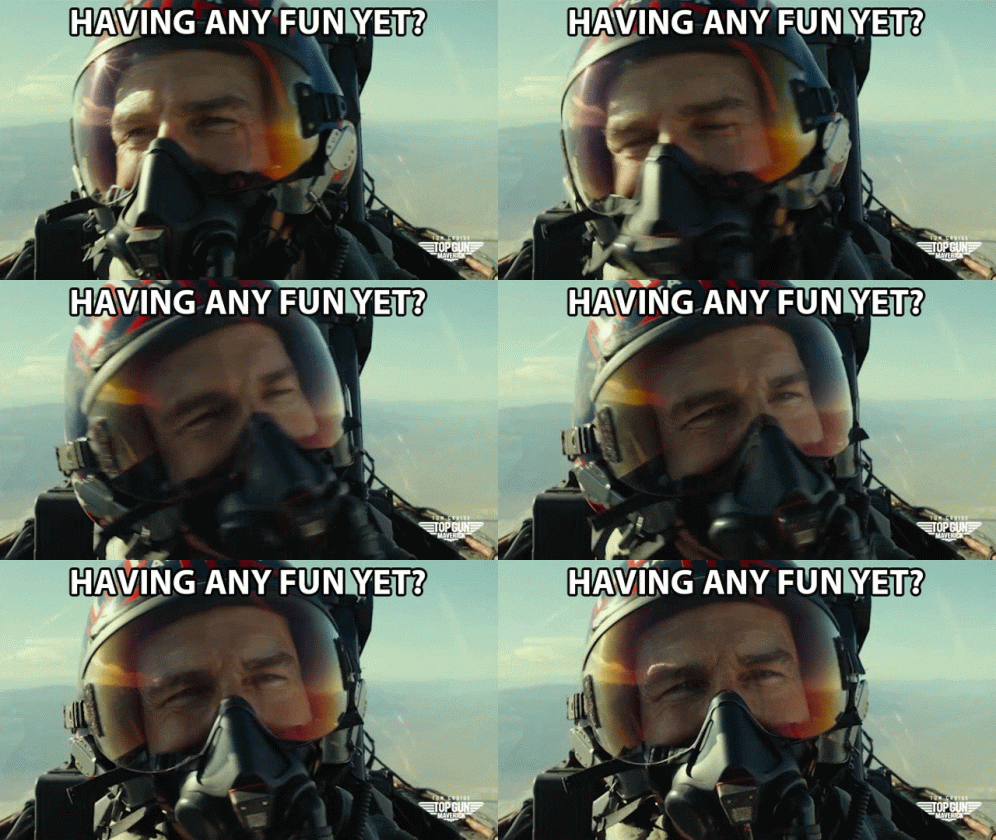
The best train in…Intermittent Hypoxia (IH)…you can too.
Same basic function...
Big difference in lung performance.
Why Your Breathing Sucks (And How to Fix It) 💨
Let me drop some truth bombs...
After age 40, your respiratory muscle strength drops about 1-2% per year. [4]
By around 60? [20]
You’ve already lost an estimated 20–40% of your breathing power.
That's like trying to run a marathon...
...breathing through a straw. 🥤
But here's the thing...
IH can reverse this decline FAST.
How fast?
Several studies showed:
✅ 25% increase in breathing muscle strength [5]
✅ Around 10-15% improvement in exercise capacity [6]
✅ 30% reduction in breathlessness [7]
✅ 50% decrease in sleep apnea episodes [21]
In fact...
In one controlled trial...
a single night of IH cut sleep apnea events by about 50%…
in people with mild–moderate OSA [21]
And this isn’t a fluke.
Researchers have been showing for years...
that carefully‑dosed intermittent hypoxia...
can re‑train the brain 🧠 and airway muscles... 🫁
to keep your throat open at night...
to make each apnea episode less likely. [8]
All from just 10-15 minutes of targeted breathing work per day.
The SEAL Breathing Protocol 🔱
Alright, enough science...
Time for action.
Here's the exact protocol Special Forces use:
Phase 1: The Power Breath (Week 1-2)
Inhale deeply through nose (4 seconds)
Hold full (2 seconds)
Exhale forcefully through pursed lips (6 seconds)
Hold empty (2 seconds)
Repeat 10 times
Do this 3x daily.
Phase 2: The Resistance Builder (Week 3-4)
Same as above, but...
Add slight resistance by:
Breathing through a straw
Or partially blocking one nostril
Or using a breathing resistance device
This forces your respiratory muscles to work harder. 💪
RANGES & TESTS:
Want to track your lung gains? Here's what to measure:
Respiratory Function Tests:
Normal Peak Expiratory Flow for men 40-60?
• 550-650 L/min. [9]
That’s what healthy lungs pump out.
But age, poor training, and sedentary life steal that power fast.
Normal Maximum Inspiratory Pressure for men?
• >80 cmH₂O.
Drop below that...
and your breathing muscles are clinically weak.
Steals your power. Endurance. And recovery. [10]
Normal Forced Vital Capacity (FVC) for men?
• >80% of predicted value.
Drop below…
Restrictive lung disease territory.
Limits your lung volume. Oxygen. Performance [11]
Sleep Quality Markers:
Apnea-Hypopnea Index (AHI): [12]
Normal: <5 events/hour
Mild sleep apnea: 5-14 events/hour
Moderate: 15-30 events/hour
Severe: >30 events/hour
>5? You’re already in apnea territory.
Steals your deep sleep. Testosterone. Morning energy.
Normal SpO2 during sleep?
• >90%
Dips below…
Chronic oxygen starvation.
Kills your recovery. Hormones. Brain fog.
You should stay above 90% during sleep [13]
Here's what else happens when you train with IH:
Stronger diaphragm = tighter esophageal sphincter.
• Cuts acid reflux. Improves digestion. Better sleep. [14]
Your core stability improves…
because breathing muscles = core muscles.
• Diaphragm + abs = rock-solid spine. Better posture. Less back pain. [15]
Your blood pressure drops...
(one study showed 12 point reduction in just 6 weeks!) [16]
• Cuts heart strain. Stroke risk. Daily stress.
Your stress hormones plummet…
• because proper breathing… activates your parasympathetic nervous system.
• That means… You crush cortisol. Clear brain fog. Sleep like a baby. [17]
The Bottom Line 💯
Look...
You can spend $1,700 on a CPAP machine + mask + supplies…
that makes you look like Darth Vader... 🤖
Or you can spend 15 minutes a day...
training your respiratory system like a Special Ops warrior.
Which sounds better to you?
Tomorrow, we dive into something even more powerful...
How IH literally grows new blood vessels in your heart... ❤️
(Yes, you read that right - NEW blood vessels)
And why cardiologists are calling it...
“The most exciting development in heart health in 20 years.”
To breathing like a Navy SEAL,
Mens Health Secrets
–Live Past 100
P.S. Tomorrow I'll reveal the "Cardiac Collateral Protocol" that builds backup highways for blood flow... even if your main arteries are 70% blocked. Your heart will feel 20 years younger... 💓
P.P.S. Boring disclaimer: Always check with your doctor... before you start any new health protocol or treatment. This includes any recommendations from our newsletter (Mens Health Secrets). This information is for entertainment and educational purposes only... and is not a substitute for professional medical advice. Mens Health Secrets is not legally responsible for any actions you do... or not do from reading our newsletter.
P.P.P.S. >>> Go here to subscribe to our Mens Health Secrets YouTube Channel if you haven't yet... leave a comment... and level up your Mens Health knowledge to live longer.
Medical References:
[1] Sheel AW. Respiratory muscle training in healthy individuals: physiological rationale and implications for exercise performance. Sports Med. 2002;32(9):567-81. https://doi.org/10.2165/00007256-200232090-00003
[2] Mitchell, G.S. (2008). Respiratory plasticity following intermittent hypoxia: a guide for novel therapeutic approaches to ventilatory control disorders?. In: Genetic Basis for Respiratory Control Disorders. Springer, Boston, MA. https://doi.org/10.1007/978-0-387-70765-5_17
[3] Panza GS, Puri S, Lin HS, Badr MS, Mateika JH. Daily Exposure to Mild Intermittent Hypoxia Reduces Blood Pressure in Male Patients with Obstructive Sleep Apnea and Hypertension. Am J Respir Crit Care Med. 2022;205(8):949-958. https://doi.org/10.1164/rccm.202108-1808OC
[4] Janssens JP, Pache JC, Nicod LP. Physiological changes in respiratory function associated with ageing. Eur Respir J. 1999;13(1):197-205. https://doi.org/10.1034/j.1399-3003.1999.13a36.x
[5] Salazar-Martínez, E., Rodríguez-Fernández, A., Camacho-Cardenosa, A., Timón, R., & Camacho-Cardenosa, M. (2019). Putative role of respiratory muscle training to improve endurance performance in hypoxia: A review. Frontiers in Physiology, 9, 1970. https://doi.org/10.3389/fphys.2018.01970
[6] Burtscher M, Gatterer H, Szubski C, et al. Effects of interval hypoxia on exercise tolerance: special focus on patients with CAD or COPD. Sleep Breath. 2010;14(3):209-20. https://doi.org/10.1007/s11325-009-0289-8
[7] Güell, M. R., Resqueti, V., Sangenís, M., Morante, F., Martorell, B., Casan, P., & Guyatt, G. H. (2006). Effects of 3-week outpatient pulmonary rehabilitation on exercise capacity, dyspnea, and quality of life in COPD. Chest, 129(4), 899–904. https://doi.org/10.1378/chest.129.4.899
[8] Mateika JH, Syed Z. Intermittent hypoxia, respiratory plasticity and sleep apnea in humans: present knowledge and future investigations. Respir Physiol Neurobiol. 2013;188(3):289-300. https://doi.org/10.1016/j.resp.2013.04.010
[9] Hankinson, J. L., Odencrantz, J. R., & Fedan, K. B. (1999). Spirometric reference values from a sample of the general U.S. population. American Journal of Respiratory and Critical Care Medicine, 159(1), 179–187. https://doi.org/10.1164/ajrccm.159.1.9712108
[10] ATS/ERS Statement on respiratory muscle testing. Am J Respir Crit Care Med. 2002;166(4):518-624. https://doi.org/10.1164/rccm.166.4.518
[11] Pellegrino R, Viegi G, Brusasco V, et al. Interpretative strategies for lung function tests. Eur Respir J. 2005;26(5):948-68. https://doi.org/10.1183/09031936.05.00035205
[12] Berry RB, Brooks R, Gamaldo CE, et al. The AASM Manual for the Scoring of Sleep and Associated Events. American Academy of Sleep Medicine; 2017. https://aasm.org/clinical-resources/scoring-manual/
[13] Berry, R. B., Brooks, R., Gamaldo, C. E., Harding, S. M., Lloyd, R. M., Marcus, C. L., & Vaughn, B. V. (for the American Academy of Sleep Medicine). (2023). The AASM manual for the scoring of sleep and associated events: Rules, terminology and technical specifications, version 3. American Academy of Sleep Medicine. https://aasm.org/clinical-resources/scoring-manual/
[14] Khaliliyaev, N., Hamdy, S., & Mittal, R. K. (2024). Selective dysfunction of the crural diaphragm in patients with chronic restrictive and obstructive lung disease. Neurogastroenterology & Motility, 36(3), e14700. https://doi.org/10.1111/nmo.14699
[15] Hodges, P. W., & Gandevia, S. C. (2000). Activation of the human diaphragm during a repetitive postural task. Journal of Physiology, 522(1), 165–175. https://doi.org/10.1111/j.1469-7793.2000.t01-1-00165.x
[16] Ferreira JB, Plentz RD, Stein C, et al. Inspiratory muscle training reduces blood pressure and sympathetic activity in hypertensive patients: a randomized controlled trial. Int J Cardiol. 2013;166(1):61-7. https://doi.org/10.1016/j.ijcard.2011.09.069
[17] Zaccaro A, Piarulli A, Laurino M, et al. How Breath-Control Can Change Your Life: A Systematic Review on Psycho-Physiological Correlates of Slow Breathing. Front Hum Neurosci. 2018;12:353. https://doi.org/10.3389/fnhum.2018.00353
[18] MacFarlane, P. M., & Mitchell, G. S. (2008). Respiratory long-term facilitation following intermittent hypoxia requires reactive oxygen species formation. Neuroscience, 152(1), 189–197. https://doi.org/10.1016/j.neuroscience.2007.12.003
[19] Dale, E. A., Ben Mabrouk, F., & Mitchell, G. S. (2014). Unexpected benefits of intermittent hypoxia: Enhanced respiratory and nonrespiratory motor function. Physiology, 29(1), 39–48. https://doi.org/10.1152/physiol.00012.2013
[20] Lauretani, F., Galetta, F., Maggio, M., Bendinelli, S., Ceda, G. P., Bandinelli, S., … Ferrucci, L. (2010). Relationship between respiratory muscle strength and physical performance in older persons: The InCHIANTI Study. Rejuvenation Research, 13(3), 281–287. https://doi.org/10.1089/rej.2009.0921
[21] Zha, S., Liu, Y., Wu, D., Wang, Y., Zhang, Y., & Zhang, X. (2024). A randomized controlled crossover trial of acute intermittent and continuous hypoxia exposure in mild-moderate obstructive sleep apnea: A feasibility study. Respiratory Physiology & Neurobiology, 329, Article 104854. https://doi.org/10.1016/j.resp.2024.104854